SHARGEEK 170 - 140W Power Bank with a SCREEN That Tells All
As an Amazon Associate we earn from qualifying purchases, at no extra cost to you.
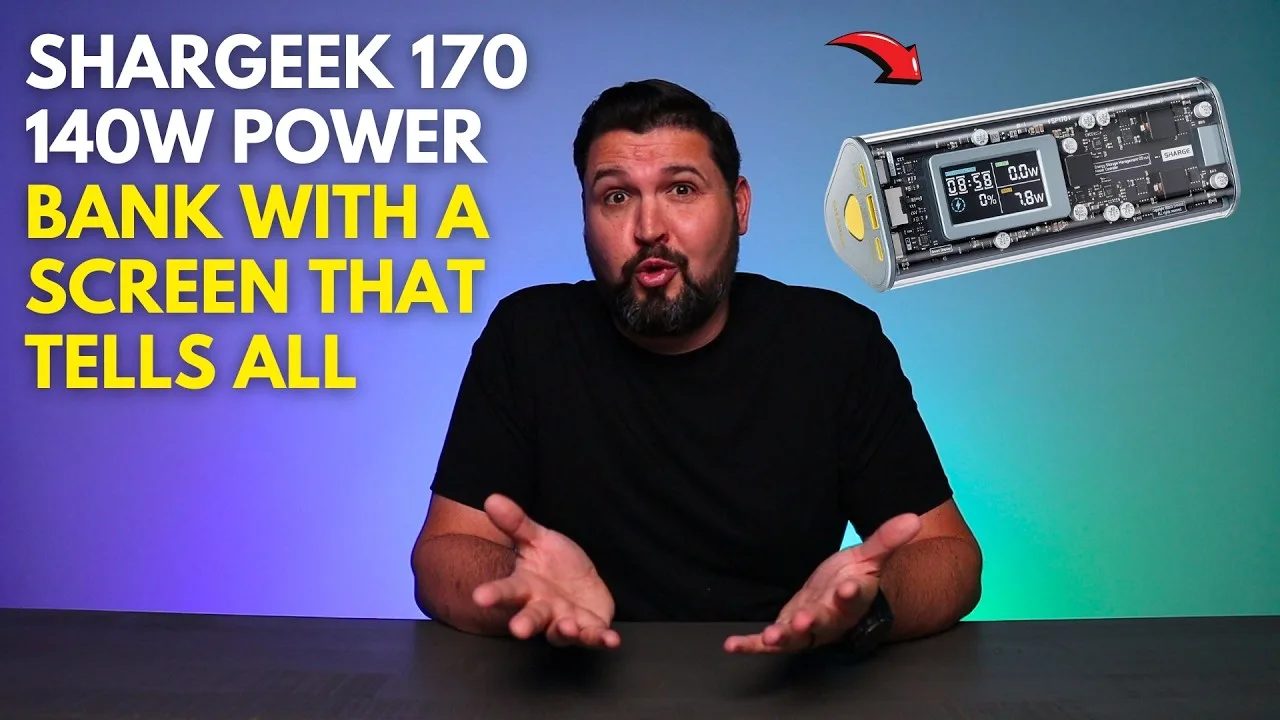
The SHARGEEK 170 is a 24,000mAh, 140W portable charger reviewed by CommQuest, and it earns its place in a heavy traveler’s bag by delivering enough output to actually fast charge a laptop while keeping other devices topped off at the same time.
What You’re Actually Getting
The core pitch here is capacity plus power. Most power banks in this size range compromise on one or the other. Either they hold a lot of charge but push weak wattage, or they hit high output numbers but run dry fast. The SHARGEEK 170, rated at 24,000mAh and 86.4Wh, pairs that big reservoir with up to 140 watts of total output. That combination is what makes it practical for people carrying real gear, not just a phone and some earbuds.
The built-in display is also worth calling out specifically. It shows remaining capacity, what devices are drawing power, and how fast the charge is going out. That sounds like a small thing until you’re sitting in an airport managing three devices and you actually need to know whether you’ll make it through the flight. A percentage number is useful. Live wattage draw is better.
What the Reviewer Actually Noticed
CommQuest zeroes in on a few real-world scenarios rather than just reading specs out loud, which is the right approach for a product like this. A laptop at 20 percent on a long-haul flight with no outlet. A full day of moving between meetings without sitting down at a desk. These are the situations where a weak or slow power bank just doesn’t cut it.
The point made about 140 watts “in practice” is worth paying attention to. A lot of power banks advertise high wattage but can only hit that number on one port under specific conditions. CommQuest’s framing, that a laptop “starts pulling serious wattage, not trickling along, actually charging,” speaks to the frustration anyone has had plugging into a lesser bank and watching their laptop still drain at 1 percent per minute. Whether the SHARGEEK 170 consistently delivers that experience across all ports and device combinations isn’t fully detailed in the review, but the emphasis on real charging speed rather than just spec claims is the right thing to highlight.
The 24,000mAh capacity also gets framed as freedom from rationing. If you’ve ever spent a day mentally calculating which device gets the next charge and which one has to wait, that framing will land.
Who This Is For
This isn’t a light pocket charger. CommQuest is clear that this is built for a specific kind of user: the road warrior with a full backpack, the remote worker who can’t afford to run out before the day ends. If you’re traveling with a laptop as your primary work machine and you need that laptop to be reliably charged away from outlets, the SHARGEEK 170 is aimed directly at you.
If you’re mostly charging a phone and occasionally a pair of wireless earbuds, you’re probably carrying more hardware than you need. But for the multi-device traveler who has had one too many dead-battery moments at bad times, the capacity and the 140W ceiling make this a legitimately compelling option.
The display alone separates it from most competitors in this space. Being able to see your power situation at a glance, including real-time draw, gives you actual information to make decisions with. That’s a small feature that adds up to a lot over a long travel day.
Common questions
- How much power does the SHARGEEK 170 have?
- It carries 24,000mAh of capacity, rated at 86.4Wh, and delivers up to 140W of output.
- Can the SHARGEEK 170 charge a laptop?
- Yes. CommQuest specifically highlights its ability to fast charge a laptop, describing it as delivering serious wattage rather than a slow trickle.
- What does the built-in screen show?
- The display shows remaining battery capacity, which devices are connected and drawing power, and how fast charge is going out in real time.
- Can it charge multiple devices at the same time?
- CommQuest describes using it to keep a phone, tablet, and earbuds topped off simultaneously over a full workday, suggesting multi-device use is a core part of its design.